Wednesday, 29 February 2012

Canada: Truth and Reconciliation Commission To Release Interim Report


VANCOUVER - A commission set up to help First Nations heal from abuses they suffered in residential schools is about to release an interim report and a new historical publication.

The Truth and Reconciliation Commission of Canada will release the documents during a presentation this morning at Simon Fraser University's downtown Vancouver campus.

About 150,000 aboriginal children were forced to attend the schools, the first of which opened in the 1870s and the last of which closed in 1996.

The CBC says it obtained a leaked copy of the interim report and that it contains 20 recommendations that address such areas of education, health and commemoration.

The commission reportedly calls for all provinces and territories to develop residential school education materials and to hold education campaigns about the history and impact of residential schools in their jurisdictions.

The network also says the reports calls for a framed copy of Prime Minister Stephen Harper's historic formal apology to residential school survivors to be prominently displayed in every secondary school in the country.

Already, the commission has taken 25,000 statements from survivors, visited about 500 communities and has heard from about 100 former school employees.

Earlier this month, commission chairman Justice Murray Sinclair called the schools acts of genocide.

In January, one survivor testified he kept his hair short so abusers found it harder to grab him and bang his head against a wall.

The interim report comes as the commission reaches the halfway mark in its five-year mandate, with a full report due when its mandate expires in 2014.
 © The Canadian Press, 2012

Originally Posted: Friday, February 24, 2012 1:38 PM, The Canadian Press
 

Saturday, 4 February 2012

Guatemala Genocide Ruling a Triumph for Survivors

On Thursday a Guatemalan court ruled the country's former president, General Efraín Ríos Montt, will stand trial for genocide and crimes against humanity committed thirty years ago. After decades spent hiding behind parliamentary immunity he will finally be held accountable for ordering massacres, disappearances, and the systematic destruction of hundreds of communities. The last few decades have seen a revolution in the global struggle against impunity, but even for those of us who follow the pursuit of justice in Guatemala closely, Thursday's decision ranks among the most astonishing developments. Belatedly, but valiantly, a new breed of prosecutors, led by Attorney General Claudia Paz, have finally allowed his victims' pleas for justice to be heard.


In 2004 the Guatemalan government admitted before the Inter-American Court of Human Rights that Ríos Montt's regime had pursued a strategy of genocide. The case before the court back then was the Plan de Sánchez massacre in July 1982, where more than 260 people were murdered. The army arrived at dawn, rounding up the villagers, cutting off all escape routes, dividing the women into two groups; one for raping before their deaths and the other just for killing. To save bullets women were crowded into a small house that was set on fire with grenades. The Plan De Sánchez massacre was one of well over 300 massacres during the worst phase of the civil war and was by no means the largest.

The charges he is now facing rely in some part on investigations I oversaw as the Legal Director of the Center for Legal Action on Human Rights (CALDH) in Guatemala from 1997 to 2001, and that is a matter of some satisfaction. We were one of many groups committed to justice on behalf of victims, building on the work of the Commission on Historical Clarification and the Catholic Church Project to Recover the Historical Memory. No one thought justice would be quick in coming, and many assumed it was not a battle worth fighting at all. But his trial is a cause to celebrate, and to marvel at the heroic dignity of the genocide survivors who throughout decades of, vilification, attacks and even killing, have stood fast. They want the world to know the truth, how their loved ones were massacred in systematic, precision-planned operations at the hands of the General.


In the years after I worked in Guatemala, the image I carried of the plight of the genocide victims was that of the haunting face in Edvard Munch's famous painting The Scream. The pain is obvious to the observer, but there is no sound. The victims of Ríos Montt were largely uneducated peasants: even screaming at the top of their lungs, their voices were never heard.

Guatemala's civil war took the lives of 200,000 people from 1960 to 1996. The origins of the civil war can be traced to a U.S. backed coup in 1954 that deposed President Árbenz, a moderate, centrist leader, applying policies of land reform that threatened the holdings of large U.S. property owners. General Ríos Montt seized power in a coup d'état from a decrepit and corrupt military regime that was in danger of losing the civil war in March 1982. He continued a genocidal campaign against the indigenous Mayan population, implementing a scorched earth policy that was endorsed by Ronald Reagan -- who famously said that Ríos Montt was "getting a bum rap on human rights." President Clinton apologized for the coup in 1998, although not for Reagan's support.

The war ended officially in 1996 amidst calls for stability and investment from the international community. Predictably, a free trade agreement with the U.S. followed and the frenzy of privatization that followed led to ever greater inequalities in what was already one of the continent's most disparate. Guatemala has since slid into failed state territory becoming a narcotics transit zone between Colombia and Mexico, with homicide rates that are higher now than they were during the civil war. It is an impossible to compare the tragedies inflicted on the populations of Latin America in the name of so-called national security doctrines, but Guatemala's war took more civilian lives than any other in Latin America, almost all at the hands of the army and their proxies.

It is hard to overstate the damage US policy has wrought on the ordinary people of Guatemala, but the primary responsibility lies with the Guatemalans who planned and carried out these horrors. Ríos Montt is but one of many. But this is not the time to focus on him. It is a time to admire the courage of impoverished peasants who screamed for justice until their voices were finally heard.

Paul Seils -- Vice President, The International Center for Transitional Justice


Originally posted: 02/ 1/2012 12:02 pm
Source: http://www.huffingtonpost.com/paul-seils/guatemala-genocide-ruling_b_1247071.html 

Tuesday, 24 January 2012

Sierra Leone: Landmark Convictions for Use of Child Soldiers


(New York) - The war crimes court for Sierra Leone has handed down the first convictions by a UN-backed tribunal for the crime of recruiting and using child soldiers. Human Rights Watch said that these convictions are a ground-breaking step toward ending impunity for commanders who exploit hundreds of thousands of children as soldiers in conflicts worldwide.
In Freetown today, the Special Court for Sierra Leone handed down verdicts against three accused men from the rebel Armed Forces Revolutionary Council (AFRC), one of three warring factions during Sierra Leone’s 11-year brutal armed conflict, which ended in 2002. The judges found the three accused – Alex Tamba Brima, Brima Bazzy Kamara and Santigie Borbor Kanu – guilty of war crimes, crimes against humanity, and other serious violations of international humanitarian law, including the recruitment and use of child soldiers.
“This use of child soldiers is a particularly horrific crime. These children should have been learning how to read, not how to shoot an AK-47,” said Jo Becker, children’s rights advocate for Human Rights Watch. “We hope that the Special Court’s decision will protect children in other parts of the world from suffering what so many Sierra Leonean children were forced to endure.”
Thousands of children were recruited and used by all sides during Sierra Leone’s conflict, including the Revolutionary United Front (RUF), the AFRC, and the pro-government Civil Defense Forces (CDF). Children were often forcibly recruited, given drugs and used to commit atrocities. Thousands of girls were also recruited as soldiers and often subjected to sexual exploitation.
The Special Court for Sierra Leone was established in 2002 to prosecute those “who bear the greatest responsibility” for war crimes, crimes against humanity and other serious violations of international humanitarian law, along with several domestic offenses, committed since 1996. All nine defendants being prosecuted by the Special Court have been charged with the recruitment and use of child soldiers. The trial phase is complete for cases involving individuals associated with the CDF and AFRC. For accused associated with the RUF, the defense began presentation of its case this May. The Special Court began the trial of former Liberian president Charles Taylor on June 4 in The Hague.
“Commanders in many conflicts deliberately prey upon children as recruits,” said Becker. “Now that child recruiters are being brought to justice, their impunity is no longer so certain.”
The Special Court’s Appeals Chamber also issued a significant ruling in 2004 that the prohibition on the recruitment or use of children under the age of 15 had crystallized as customary international law prior to 1996, and that individuals bore criminal responsibility for such acts.
The first individual being tried by the International Criminal Court (ICC), the former militia leader Thomas Lubanga from the Democratic Republic of Congo, has also been charged with the crimes of enlisting and conscripting children as soldiers and using them to participate actively in hostilities. In March 2006, Lubanga was transferred to the ICC in The Hague.

Sunday, 22 January 2012

Transitional justice survey in Sierra Leone


Nearly 90% questioned were aware of Charles Taylor's trial.

A BBC World Service Trust survey, conducted in July 2007, found Sierra Leoneans rate the Special Court highly but say it could do better still.

The survey explored knowledge and attitudes on transitional justice issues in the wake of Sierra Leone’s civil war, which ended five years ago.

It found that more than two-thirds of Sierra Leoneans think their country’s UN-backed Special Court has performed well so far, while more than a quarter think the court is putting some wrong people on trial.

Sixty-eight percent of respondents said they think the Special Court’s performance to date has been 'good' or 'excellent.'

The Special Court for Sierra Leone


An overwhelming majority of respondents (96%) say they are aware of the Special Court, although only 4% say they know a lot about its proceedings. More than one in four report that they do not know anything about its proceedings.

The Special Court for Sierra Leone was set up in 2002 by the government and the UN to try those with 'greatest responsibility' for atrocities committed during the civil war.

Its decision to try leaders of the pro-government Civil Defence Forces (CDF) as well as the insurgent Revolutionary United Front (RUF) rebels and Armed Forces Revolutionary Council (AFRC) has generated some controversy, as has former Liberian President Charles Taylor’s transfer to Europe.

Charles Taylor

Nearly 90% of people questioned said they were aware of the court’s trial of former Liberian President Charles Taylor but only half approved its decision to try Taylor in The Hague rather than in West Africa.

More than a quarter (27%) would have preferred his trial to be held in Sierra Leone’s capital, Freetown.

The court gained custody of Taylor in 2006, for war crimes and crimes against humanity for allegedly backing Sierra Leone’s Revolutionary United Front rebels but he was transferred to The Hague after West African leaders expressed fears that holding the trial locally could destabilize the region.

His trial began in June 2007, but has been adjourned until 7th January, 2008.

Communicating Justice

The household survey was carried out nationwide with Search for Common Ground and the International Center for Transitional Justice (ICTJ).

It is part of Communicating Justice, a joint, two-year project of the BBC World Service Trust and ICTJ.

The project aims to raise levels of public awareness and debate around transitional justice issues in five post-conflict African countries: Liberia, Sierra Leone, Uganda, the Democratic Republic of Congo and Burundi.

Communicating Justice is funded mainly by the European Union and the Netherlands Ministry of Foreign Affairs, with additional funds from the US-based non-governmental organisation Humanity United.

A full report from the survey will be available later in 2007 on the project website.

The survey is based on a sample of 1,700 adults, taken from seven districts and the Western Urban and Western Rural Areas of Sierra Leone.

Participating households were selected randomly, with one respondent meeting the sample criteria being taken from each household.


The article is from the BBC, and can be found below.
http://www.bbc.co.uk/worldservice/trust/africa/story/2007/10/071004_sierra_survey.shtml


Saturday, 21 January 2012

Special Court for Sierra Leone


Established: January 2002

In order to deal with mass human rights violations that occurred during the civil war, President Ahmad Tejan Kabbah asked for the UN's help in establishing a "strong and credible court" that would prosecute those responsible for human rights violations. The Special Court for Sierra Leone thus came together under an agreement between the UN and the government of Sierra Leone.

The mandate of the SCSL is "to prosecute those who bear the greatest responsibility for serious violations of international humanitarian law and Sierra Leonean law", with the temporal jurisdiction extending to November 1996. The aim of this court was to provide relevant and accessible use of international justice to those for whom it was established, by providing it in an economical and efficient manner. These aims were established in relation to previous ad hoc tribunals, the International Criminal Tribunal for the former Yugoslavia and for Rwanda (ICTY and ICTR), both of which faced much criticism. Thus the Security Council created a new model, drawing from the lessons learned from the ICTY and ICTR.  The International Centre for Transitional Justice notes the key features of the SCSL

  • Its location in the country where the crimes occurred, a fundamental quality that was to affect its work more broadly. (It became the first ad hoc tribunal based in the country where crimes occurred). 
  • Its “mixed” or hybrid composition, including a minority of judges appointed by the government of Sierra Leone, which essentially meant that both nationals and internationals would be responsible for implementing the court’s mandate.
  • Its potential, based on its hybrid nature, to reflect knowledge of the events, reach informed judgments, and build a full judicial record of the events in Sierra Leone through fair trials.
  • Its more strictly defined mandate to focus only on “those who bear the greatest responsibility,” with the expectation that this would lead to judicial efficiency and a short timeframe for the court’s work. 
  • Its anticipated cost-effectiveness, based on a more flexible oversight mechanism through a management committee composed of the main donors and interested countries, and the expectation of reducing the running costs and avoiding UN bureaucracy.
  • Its independence from the national judiciary, while retaining the potential to have a positive impact on national institutions and legal reform, and to be closer and more relevant to the population.
  • Its ad hoc nature, meaning that it would only exist for a certain time before winding down.
Many saw the establishment of the SCSL as the implementation of a new model for international justice.

Cases at The Court

The "crown jewel" of the SCSL is the Charles Taylor case. Taylor is the former dictator president of Liberia charged with 11 counts of crimes against humanity for his involvement in the Sierra Leone Civil War. While the verdict has not come out yet on the Taylor case, the fact that Nigeria agreed to extradite Taylor, who had sought asylum in the country, is seen as a great success for international justice. 

Charles Taylor during Trial

Other cases:

The Prosecutor vs. Alex Tamba Brima, Brima Bazzy Kamara and Santigie Borbor Kanu
(the AFRC Accused)

The Prosecutor vs. Samuel Hinga Norman, Moinina Fofafana and Allieu Kondewa
(the CDF Accused)

The Prosecutor vs. Issa Hassan Sesay, Morris Kallon and Augustine Gbao (the RUF Accused)


Preliminary Findings of The Court

Many accounts agree that the trials at the SCSL are moving along, although they have slowed down, which leads to higher costs for the operation of The Court. Public outreach, one of the biggest criticism for the International Criminal Tribunal for Rwanda, is going well particularly since The Court actually exists within Sierra Leone and the proceedings are occurring in the official language of the country, English. Although, there have been some difficulties in broadcasting the updates of the Charles Taylor trial because it is actually occurring in The Hague, Netherlands since there were security concerns for West Africa with having it take place at the SCSL.


Sources: 
Dougherty, Beth K. 2004. Right-sizing international criminal justice: The hybrid experiment at the special court for sierra leone. International Affairs (Royal Institute of International Affairs 1944-) 80, no. 2, Israeli-Palestinian Conflict: pp. 311-328, http://www.jstor.org.proxy2.lib.uwo.ca:2048/stable/3569244.
International Center for Transitional Justice: Sierra Leone: http://ictj.org/our-work/regions-and-countries/sierra-leone
Special Court for Sierra Leone Website: http://www.sc-sl.org/ including the statute.


Friday, 20 January 2012

Sierra Leone Civil War

The Sierra Leone Civil War (1991-2002) began on 23 March 1991 when the Revolutionary United Front (RUF), with support from the special forces of Charles Taylor's National Patriotic Front of Liberia (NPFL), intervened in Sierra Leone in an attempt to overthrow the Joseph Momoh government. The resulting civil war lasted 11 years, leaving the nation with over 50,000 dead.


A lasting feature of the war, in which tens of thousands died, was the atrocities committed by the rebels, whose trademark was to hack off the hands or feet of their victims. The rebel Revolutionary United Front (RUF) led by Foday Sankoh has displayed a staggering capacity for brutality. In May 2000, the RUF overturned a fragile peace process and plunged the country back into war. Sankoh was captured on 17 May 2000, but this has not kept the RUF from continuing their fight and terror actions. It is well documented that the RUF is using terror tactics such as mass rape, torture and mutilation of civilians, abduction of children to become child soldiers or sex slaves and massive intimidation.

Before the outbreak of war, corruption and mismanagement in the diamond sector was one of the main reasons why Sierra Leone became, according to UN figures, the poorest country in the world. With the breakdown of state structures and the effective suppression of civilian opposition, wide corridors were opened for trafficking of arms and ammunition and drugs, all of which eroded national/regional security and facilitated crime within the country and between Sierra Leone and Liberia and even Guinea.

The RUF launched its first campaign into eastern Kailahun (Sierra Leone) from Liberia in March 1991. Sankoh was head of the military wing of the RUF that included in its ranks NPFL members and Burkinabes. According to Sierra Leonean writer Abdul Koroma, the rebels were quick to demonstrate their brutality, decapitating community leaders and putting their heads on stakes. Oxford University researcher Paul Richards claims that the Burkinabes did attempt some politicisation, but most of the lectures to villagers were delivered in French. Forced recruitment of children was also an early feature of rebel strategy. The intellectuals in the RUF opposed the methods being used, but within the first year of the rebellion, they had been eliminated in internal purges as Sankoh took over the movement. Among the victims were Kanu and Mansaray.

The Sierra Leone civilians seem to be the main target of RUF terror actions. At the beginning of May 2000, the RUF began an offensive action in the Masiaka region. Heavy reinforcements by the United Nations and British troops and a counter-offensive by government-allied militias repulsed the RUF rebels from the Masiaka area around May 14. During its week-long occupation of the area, the RUF committed well documented acts of murder, mutilation, rape, looting, and abduction against the civilian population.

Both the RUF and the government military enrolled child soldiers in defense of respective interests. This was of vital importance to the RUF’s collective power. Manipulating vulnerable minds enabled the RUF to establish an insurgent force that continually contradicted the government’s interests. The recruitment of child soldiers by both rebel groups and government forces is generally forced. Desperation for food and medical care often compels children into military life since it offers a source of income for themselves and their families.

Despite any peace agreements, Human Rights Watch reported that abuses were still continuing towards the end of 1999. Some Sierra Leone Rebels suggested that they would reject deployment of UN Peacekeeping forces if they were authorized to use force in order to disarm various factions. The process of disarmament has been slowly progressing.

In January 1999, world leaders intervened diplomatically to promote negotiations between the RUF and the government. The Lome Peace Accord, signed on 27 March 1999, was the result. Lome gave Foday Sankoh, the commander of the RUF, the vice presidency and control of Sierra Leone's diamond mines in return for a cessation of the fighting and the deployment of a UN peacekeeping force to monitor the disarmament process. RUF compliance with the disarmament process was inconsistent and, by May 2000, the rebels were advancing again upon Freetown. With help from a renewed UN mandate and Guinean air support, a British coup finally defeated the RUF. On 18 January 2002, President Kabbah declared the Sierra Leone Civil War officially over.

Sources:
http://www.bbc.co.uk/news/world-africa-14094194
http://www.globalissues.org/article/88/sierra-leone
http://www.afrol.com/News/sil007_civil_war.htm

Thursday, 19 January 2012

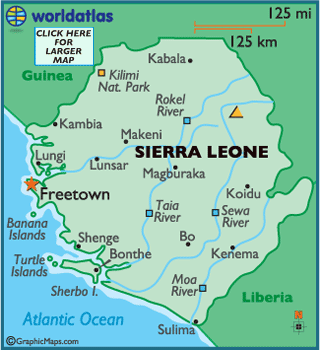
Introduction to Sierra Leone


A Brief Background on Sierra Leone

Location: West Africa, bordering the North Atlantic Ocean between Guinea and Liberia.


Religion: Muslims %60, Christian %10, Indigenous Beliefs %10

Government: Constitutional Democracy, Republic of Sierra Leone. Independent Since April 1961

Population: 5.7 million

Life Expectancy: 48 years

Ethnic groups (2008 census): 20 African ethnic groups--Temne 35%, Mende 31%, Limba 8%, Kono 5%, Creole 2% (descendants of freed Jamaican slaves who were settled in the Freetown area in the late 18th century; also known as Krio), Mandingo 2%, Loko 2%, other 15% (includes refugees from Liberia's recent civil war, and small numbers of Europeans, Lebanese, Pakistanis, and Indians)

Political parties: The Political Parties Registration Commission was formed in late 2005 to review registered parties to see whether they still met registration requirements.

Economic History

Sierra Leone is an extremely poor nation with tremendous inequality in income distribution. While it possesses substantial mineral, agricultural, and fishery resources, its physical and social infrastructure has yet to recover from the civil war, and serious social disorders continue to hamper economic development. Nearly half of the working-age population engages in subsistence agriculture. Manufacturing consists mainly of the processing of raw materials and of light manufacturing for the domestic market. Alluvial diamond mining remains the major source of hard currency earnings, accounting for nearly half of Sierra Leone's exports. The fate of the economy depends upon the maintenance of domestic peace and the continued receipt of substantial aid from abroad, which is essential to offset the severe trade imbalance and supplement government revenues. The IMF has completed a Poverty Reduction and Growth Facility program that helped stabilize economic growth and reduce inflation and in 2010 approved a new program worth $45 million over three years.

Transnational Issues

As domestic fighting among disparate ethnic groups, rebel groups, warlords, and youth gangs in Cote d'Ivoire, Guinea, Liberia, and Sierra Leone gradually abates, the number of refugees in border areas has begun to slowly dwindle; Sierra Leone considers excessive Guinea's definition of the flood plain limits to define the left bank boundary of the Makona and Moa rivers and protests Guinea's continued occupation of these lands including the hamlet of Yenga occupied since 1998.

Information provided by World Factbook: https://www.cia.gov/library/publications/the-world-factbook/geos/sl.html